
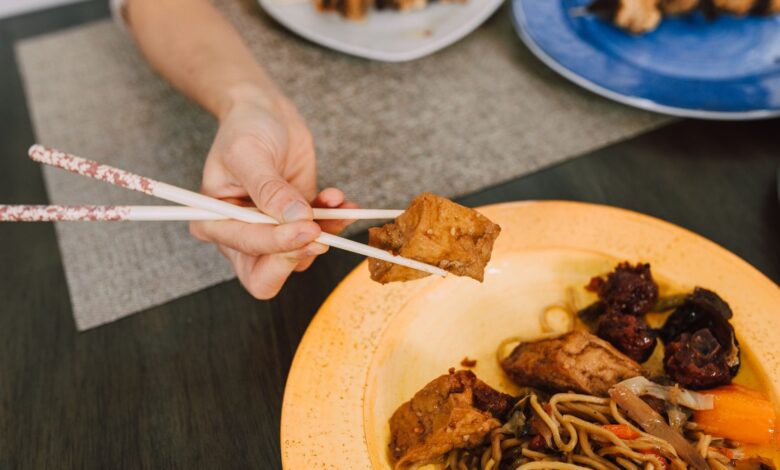
Two things you can do with a pair of chopsticks will genuinely unsettle the people you are eating with in Japan. Almost everything else filed under table manners in Japan is ordinary courtesy, and breaking it costs nothing. You can see how uneven the stakes are in the official guidance Japan publishes for visitors, which tells them to slurp their noodles, bring the dish to their mouth rather than their mouth to the dish, and try to finish the meal — three habits that would read as poor manners at a Western table.
The difference has nothing to do with how well you handle chopsticks. The two gestures that land badly do so because they copy something people only do at a funeral, which is why they register instantly — and why the two short phrases that bookend a Japanese meal buy more goodwill than a flawless grip ever will. None of it lands until you read the table the other way round from home.
Why the Japanese Table Plays by Different Rules
Open any list of Japanese dining rules and you will find twenty items stacked in a row with nothing to tell you which one matters. Japan’s own tourism body does it too: on the same short list of do’s and don’ts, “feel free to slurp your noodles” sits beside “don’t put your elbows on the table,” formatted identically, as though a visitor should budget the same attention for both. The list is accurate. It just isn’t graded, and the grading is the part you actually need.
Everything below was checked on 20 September 2026 and describes custom rather than law — no rule here is enforced by anyone, none of it changes according to which passport you carry, and practice genuinely varies between a Tokyo izakaya, a family restaurant and a meal in someone’s home, so the room you are sitting in is a better authority than any article.
Start with the inversions, because they are where a careful Western diner goes wrong by trying hard. Lifting a small bowl off the table and holding it near your chest is correct here. The Tokyo Metropolitan Government’s own dining guidance says holding bowls while eating looks polite and attentive, and that leaving the bowl down while you bend toward it is the careless-looking option. Noise works backwards too. Slurping noodles is fine and reads as appreciation, while the quiet, tidy, plate-flat performance you were raised on communicates nothing at all.
So the rules are not stricter than yours. They are sorted differently, and the sorting principle is simple: a rule matters in Japan to the extent that the table visibly reacts to it. Most of the list produces no reaction whatsoever.
That distinction is not an editorial invention, and you can watch people draw it themselves. In a thread on r/NoStupidQuestions asking whether Japanese table etiquette is followed in everyday life or reserved for formal occasions, a commenter who said they had lived in Japan for about eight years answered by splitting the list in two: never stand your chopsticks up in your rice, because “this is what they only do at funerals” — and, in the same breath, that the formal rule about touching food with only the first two centimetres of the chopstick is something “no one follows this in everyday life.”
One real rule, one dead letter, printed side by side on every list the reader has seen.
Sorting the list is the whole job, and the top of it is very short.
The Two Chopstick Moves That Genuinely Upset People — and Why
Stand your chopsticks upright in a bowl of rice, or take food directly from another person’s chopsticks with your own, and you have reproduced a funeral. Not resembled one loosely. Reproduced the specific gesture.
The second one is the sharper of the two, and it is worth knowing exactly what it copies. After a cremation in Japan, the family gathers at the crematorium and moves the bones from the ashes into the urn — a rite called kotsuage, performed with long ceremonial chopsticks, with two relatives holding the same fragment at once or passing it from one pair of chopsticks to another. That is the only occasion on which two people in Japan properly hold a single item with chopsticks at the same time.
Every other time it happens, it reads as a funeral quotation performed over a plate of grilled fish — which is why it is treated as a serious lapse rather than a clumsy one.
The upright chopsticks work the same way, through a different object. Rice set before a Buddhist altar for the dead is served with the chopsticks planted vertically in it, and incense offered to the dead is stood upright in the same fashion. Push your chopsticks into a rice bowl to park them and you have built a small version of the same image in front of everyone at the table.
Japan’s official visitor guidance names both gestures directly rather than burying them: the Tokyo Metropolitan Government’s washoku etiquette guide, reviewed by a Japanese etiquette-school director, lists passing food from chopstick to chopstick — hashi-watashi — among the actions avoided in Japan precisely because they are associated with funeral customs. Be aware that the naming is not stable across sources; different guides attach different Japanese labels to the same act, so recognise the gesture rather than memorising the term.
There is also a plainer reason people flinch, and it is worth holding alongside the funeral one. Answering a traveller on r/JapanTravelTips who asked how strict chopstick manners really are, a commenter writing as a Japanese person listed the moment two diners bring chopstick-held food together as one of a handful of things they find uncomfortable, and gave hygiene as the reason: the tips have been in someone’s mouth, and watching them approach each other is unpleasant. Two separate discomforts, one gesture. You do not need to know which one you triggered.
The recovery matters more than the apology, and it follows directly from the mechanism. Because the problem is an image the table has just seen, a long, visible apology holds that image in the room for another thirty seconds. Take the chopsticks out, rest them properly, say a quiet “sumimasen” if the moment calls for one, and carry on with the conversation. The gesture is understood as unfamiliarity when it comes from a visitor; it is the staging that makes it awkward.
Which raises the question the rule creates: if the rice bowl is off limits, where do the chopsticks actually go?
Where to Put Your Chopsticks When You’re Not Eating
They go on a rest, and most settings give you one. The small ceramic or wooden object beside your setting is a hashioki — hashi meaning chopsticks and oki from the verb “to place” — and it exists for exactly this problem. Tips on the rest, pointing left, the pair lying parallel to the table edge. Tokyo’s official dining guidance puts it plainly: when you are not using your chopsticks, they belong on the rest.
If there is no rest, the paper sleeve your disposable chopsticks came in becomes one. Fold it into a knot or a flat concertina and you have made a serviceable rest in about four seconds, which is ordinary practice rather than a party trick. Failing that, the rim of a small plate holds them fine.
There is one genuine nuance here, and most lists flatten it. Laying your chopsticks across the top of your bowl like a bridge is not a taboo, but it is not neutral either: in formal usage it signals that you have finished and want nothing more. Do it while pausing mid-meal and you may find your dishes being cleared. Do it at the end of the meal and you have said exactly what you meant. The gesture is a message, not an offence, which is why it depends entirely on when you use it.
The end of the meal has its own small choreography, and it is easier than it sounds. The convention is to return the table roughly to the state it started in — lids back on the bowls they came from, dishes moved back to their original positions, chopsticks laid down together, either on the rest or slid back into their paper sleeve. Tokyo’s guidance adds one detail worth catching: do not stack the dishes, however helpful stacking feels.
Here is a check you can run in the first thirty seconds of your first meal, before any of this is under pressure. Look at how the setting arrived: rice on your left, soup on the right, the main dish behind them, chopsticks lying horizontally in front of you with the tips pointing left. That layout is deliberate — Tokyo’s guidance explains it is built around right-handed chopstick use — and it is also the picture you are putting back at the end. If you can see the arrangement at the start, you do not have to remember it later.
With the chopsticks parked, the more useful half of the meal opens up: the part you say out loud.
What to Say Before and After a Japanese Meal (Itadakimasu and Gochisousama)
Two phrases carry more weight than every chopstick rule combined, and neither one is hard. “Itadakimasu” opens the meal. “Gochisousama deshita” closes it. Say both, badly, and you will land better than a silent diner with immaculate technique.
What they actually mean is where most guides go wrong. Itadakimasu is routinely translated as “let’s eat,” as though it were addressed to the other people at the table — it isn’t. Japan’s Ministry of Agriculture, Forestry and Fisheries, in its own booklet on the country’s dietary culture, defines the pair as thanks that reaches past the cook to the nature the ingredients grew in, and to ancestors and deities. Coto Japanese Academy, a Japanese language school in Tokyo, traces the grammar to the same place: itadakimasu is the humble form of the verb “to receive,” so the literal sense is “I humbly receive.” The phrase is spoken by the eater about the food, not to the company.
Gochisousama deshita has a picture inside it too. The characters in gochisou carry the sense of running around — horse and run — because a host once had to travel to hunt and gather the ingredients. Saying it tells the cook, in effect, that you know they went to trouble.
The mechanics are unfussy. Palms together in front of your chest, a slight nod, then pick up the chopsticks. In a group, wait for the host or the eldest person to go first; in a restaurant, nobody is timing you. At the end, chopsticks down first, then the phrase. The form also shifts with the setting: gochisousama on its own is the casual version for friends and family, while gochisousama deshita is the polite form used in restaurants, which is the one worth defaulting to.
The extension most visitors miss is the exit. In a small ramen shop you will hear people call gochisousama deshita toward the kitchen on their way out, or say it to the cashier while paying. Nobody expects it from you, which is precisely why it registers.
The table below pairs each moment of the meal with what to do, what to say, and roughly how it sounds. The pronunciations are approximate sound-spellings built as a reader’s aid, not a formal transliteration system, and they are close enough to be understood.
| Moment | What to do | What to say | Roughly how it sounds |
|---|---|---|---|
| Everyone has been served | Palms together, small nod, then pick up chopsticks | Itadakimasu | ee-tah-dah-kee-mahss |
| Your dish arrives first | Start if it is better hot, with a word first | Osaki ni itadakimasu | oh-sah-kee nee ee-tah-dah-kee-mahss |
| Drinks arrive | Wait for the toast before drinking | Kanpai | kahn-pie |
| Pausing mid-meal | Chopsticks on the rest, never in the food | Nothing needed | — |
| Finished eating | Chopsticks down, dishes back as they started | Gochisousama deshita | go-chee-soh-sah-mah desh-tah |
| Leaving the restaurant | Said toward the kitchen or at the till | Gochisousama deshita | go-chee-soh-sah-mah desh-tah |
| Eating with friends or family | The short form is enough | Gochisousama | go-chee-soh-sah-mah |
The column that does the real work is the first one. Most people can already say these phrases after one read; what they lack is the trigger that tells them when. Attach each phrase to a moment you can see happening — the last dish landing, the glasses going up, your chopsticks going down — and you will not have to remember anything at the table.
Which leaves the long list of things you have been quietly worrying about since you started reading.
The Japanese Table Rules You Can Actually Relax — Forks Included
Your grip is not being assessed. Neither is your speed, your accuracy, or how much you drop. The threads where nervous travellers ask about this are unusually consistent: on the same discussion about how strict chopstick manners really are, one commenter’s summary was that there are “barely a handful of things it’s best not to do, even then it’s only like two things you shouldn’t do with them,” naming the funeral pair and adding that little else is noticed. Another reply put the practical version more bluntly — it does not matter at all if you are bad at using chopsticks, and people are pleased to see you trying.
The fork is the question people are most embarrassed to ask, and the answer is boring. Ask for one. Casual restaurants, family restaurants and anywhere used to foreign customers will produce a fork without comment, and plenty of dishes come with cutlery anyway — Japanese curry and rice bowls are routinely served with a large spoon because they are awkward with chopsticks, which tells you the country is not ideological about this. Two honest limits: a small traditional place may simply not own a fork, and at a sushi counter the food is built to be eaten with chopsticks or fingers, so the request lands oddly there rather than rudely.
In that setting the better move is to ask the chef how a particular piece is meant to be eaten, which is a question Japanese diners ask constantly.
Slurping deserves a word, because the advice has overcorrected. It is genuinely fine — Tokyo’s own guidance treats noodles as the standing exception to eating quietly — but it is not compulsory, and no one is offended by a visitor who eats noodles silently. You are being given permission, not an instruction.
One item usually filed under “relax” does not belong there, and it is worth being straight about the disagreement. Elbows on the table appear as a “don’t” in Japan’s national tourism guidance and again in Tokyo’s washoku etiquette guide, which asks diners not to rest elbows on the table or let the free hand hang down. Set against that, nobody in any of the traveller discussions reports being corrected for it. Both things are true: it is real etiquette, and it is not the sort of etiquette anyone will mention. Treat it as posture rather than a trap.
The pattern underneath all of this is that the relaxed tier is about competence, and competence is not what the table is reading. What it does read is attention — which is where the last group of rules lives.
The Quiet Courtesies That Actually Get Noticed
These are the ones nobody will scold you for and several people will notice you doing. They cost almost nothing and they are the difference between a visitor who was fed and a guest who was welcome.
Finishing your food is the one most often taught badly. The instruction circulating online is to clear the plate to the last grain or cause offence, which turns a meal into an ordeal for anyone with a small appetite.
Tokyo’s official guidance is both gentler and more useful: try not to leave rice behind, and if you know you eat little, tell the staff in advance so the portion can be adjusted and nothing is wasted. The value being protected is not your clean plate but the food itself, which means the polite move happens when you order, not when you are defeated halfway through. Japan’s tourism body frames it the same way: try your best to finish, rather than finish or else.
Shared dishes have one convention worth learning because it is the one that gets noticed when it is skipped. Food goes from the communal plate to your own small plate first, and you eat from your plate. If serving chopsticks have been provided, use them; where none appear, the widely taught fallback is to turn your own chopsticks around and take the food with the ends that have not been in your mouth. Neither move is fussiness — it is the same hygiene instinct that makes chopstick tips touching uncomfortable, applied to food everyone is sharing.
The wet towel handed to you when you sit down is an oshibori, and it is for your hands, before you eat. Not your face, not the table, not a spill. That is the rule as the reference guides state it, though in practice it is softer than it reads — opinions among people who live in Japan differ on the face question, and you will see men in casual places do it. Hands only is simply the version nobody questions.
Drinks run on reciprocity. Nobody drinks until everyone has a glass and the toast has happened, and you pour for the people around you rather than for yourself, keeping half an eye on whose glass is emptying. If someone moves to fill yours, drink a little first, then hold the glass out toward them. If you do not drink alcohol, say so — alcohol-free beer, tea and soft drinks are standard, and declining is unremarkable.
Allergies and foods you cannot eat belong in the same category as portion size: they are an ordering conversation, not a table problem. Tell the restaurant when you order or, better, when you book, and be specific. This is courtesy guidance rather than a safety guarantee — no restaurant is promising that a dish is free of an allergen because you mentioned it, and a serious allergy is a conversation with the venue and your doctor, not something an article can settle. Dining customs and house practice vary by restaurant and by region and do change over time, so on the day, the staff in front of you and the venue’s own notices are what you check against.
A last, smaller one: soy sauce goes in the dish provided, in a small amount, and not over a bowl of plain white rice. And if your trip anxiety runs past the table — shoes, trains, onsen, tipping — that belongs to a broader guide on Japanese etiquette beyond the table rather than to this one.
The Mistake That Costs the Most
The costly mistake is not using the wrong grip or forgetting which side the rice bowl sits on; it is spreading your attention evenly across twenty rules and therefore giving the two that matter no more weight than the nineteen that don’t. Keep your chopsticks out of the rice and off another person’s chopsticks, put them on the rest whenever you pause, and say the two phrases — and you have covered everything anyone at the table will register. If you want to check the details against a source that is not a blog, Japan’s national tourism organisation publishes its own etiquette guidance for visitors.
The traveller who relaxes and eats well is a better guest than the one who gets every rule right and enjoys nothing.
Frequently asked questions
Should I rub disposable chopsticks together to get rid of splinters?
No — this is one of the few habits that reliably lands badly. Rubbing them implies the restaurant handed you cheap, rough chopsticks, and it scatters splinters onto the table, which reads as unhygienic. If a pair genuinely has a rough edge, quietly ask for another.
Can I eat sushi with my hands?
Yes, and at a sushi counter it is entirely normal. Nigiri is designed to be picked up either way, so hands or chopsticks are both correct, and sashimi is eaten with chopsticks. Dip the fish side into the soy sauce rather than the rice, which otherwise soaks it up and falls apart.
What if I’m seated on tatami and can’t kneel comfortably?
You do not have to force it. Tokyo’s official dining guidance says kneeling is the ideal in a traditional tatami room but that discomfort is not the point, and many restaurants now have sunken floor seating that lets you sit normally with your legs down. Shoes and slippers come off before you step onto tatami.
